

How scoring works
1. An AI reads the resume against each requirement
The resume is read into clear sections (experience, skills, education), and an AI assessor judges each requirement on your Role Card as Met, Partial or Missing, quoting the lines it relied on. It's told to use only what the resume actually shows. A skill that only appears in a Skills list, or is named in a job without an example of using it, counts as Partial, not Met. Before scoring, the candidate's name, email, phone, address, profile links and graduation years are removed, so they can't influence the verdicts.
2. Code checks the AI's work
Every quote is matched back to the resume text. If the words aren't on the page, the requirement doesn't get credit, so the AI can't credit a skill the candidate never wrote. Years are counted by code from the dates of the jobs whose title or bullets name the skill. Every requirement gets a second, independent AI pass, and a third breaks the tie when the two disagree. The AI runs with its randomness turned down as far as it goes. A borderline requirement can still occasionally land differently on a re-score, which is one more reason every verdict shows its evidence.
3. The score is simple math you can see
Critical requirements count three times as much as Nice-to-haves. Met earns full credit, Partial half, Missing none. Some gaps cap the score so a strong-looking total can't hide them. A failed deal-breaker caps it at 45. By default, one Critical missing caps it at 45, two or more at 30, and a Critical with only Partial evidence at 65 (a role can switch these Critical caps off). When a cap applies, Tersen shows the raw score, the cap and the reason. The AI suggestion follows the score: 70 and up is Hire, 50 to 69 is Maybe, under 50 is Pass. A "Close to the line" badge means the score is within 5 points of your Hire or Maybe cutoff, so the suggestion could reasonably go either way. Check the evidence before you decide.
4. A person makes every decision
The AI suggestion is a badge, not a decision. Every candidate starts Undecided and stays visible until you choose Hire, Maybe or Pass. Tersen never rejects, hides or emails anyone on its own.
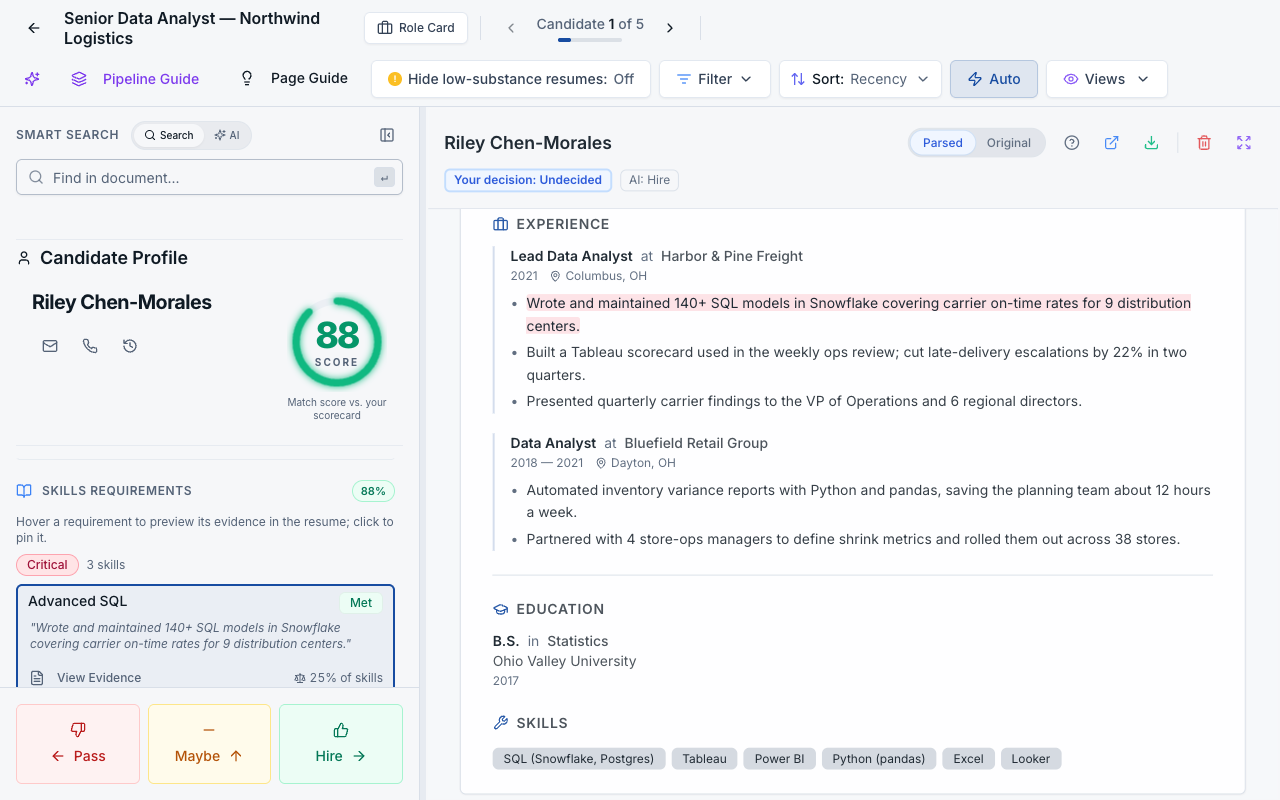
The exact line a verdict is based on, highlighted in the resume.
The models we use
Where AI is used, and where it isn't.
How your data is handled
OpenAI is a processor, not a partner. Résumé text is sent to OpenAI only to read it into structured fields and assess it against your Role Card, under a data-processing agreement. OpenAI does not use this data to train its models, and maintains SOC 2 Type 2 compliance.
Encrypted end to end. All data is encrypted in transit (TLS 1.2+) and at rest (AES-256), and every user's candidate data is strictly isolated from every other account.
No automated decisions. Tersen surfaces evidence and recommendations, but a human always makes the final hiring decision.
Related reading
See it in action
Try the interactive demo to watch evidence-based scoring work on a real résumé — no sign-up required.