

Methodology
Every score comes from documented rules you can check, not a black box. Here's exactly how it works, in plain English.
An AI reads, code checks
An AI assessor reads each resume against every requirement on your Role Card and marks it Met, Partial or Missing, quoting the lines it relied on. Code then checks the work: every quote must appear in the resume or the requirement gets no credit, years are counted by code from the dates of the jobs whose title or bullets name the skill, and every requirement gets a second, independent pass. A skill that's only listed, or named without an example of using it, counts as Partial.
How the score adds up
Each requirement earns credit: Met earns full credit, Partial half, Missing none. Critical requirements count three times as much as Nice-to-haves. The score is the credit earned out of the total possible, on a 0–100 scale. The Trust Card groups requirements by section (Skills, Experience, Location & Authorization, and so on) so you can see where a candidate is strong or thin.
Critical gaps cap the score
A failed deal-breaker (hard constraint) caps the score at 45. By default, one missing Critical caps it at 45, two or more at 30, and a Critical with only Partial evidence at 65; a role can switch these Critical caps off. This overrides the math on purpose: a candidate who's a strong fit on paper but missing a must-have shouldn't be suggested as a strong match. Tersen shows the raw score, the cap and the reason. The AI suggestion follows the score: 70 and up is Hire, 50 to 69 is Maybe, under 50 is Pass.
You always make the final call
Tersen ranks and surfaces evidence to speed up review. It never auto-rejects or auto-hires anyone; candidate status only ever changes when a person makes that decision. Every recommendation is a starting point, and the evidence behind any score is always inspectable before you decide. See our Privacy Policy for the full automated-decision-making disclosure.
What the model does and doesn't see
Before scoring, the candidate's name, email, phone, address, profile links and graduation years are removed from the text the AI reads. Scoring never uses photo, age, gender or any protected characteristic as an input. It is not trained on your candidate data, and OpenAI does not use API data to train its own models (see our subprocessors page for the DPA reference).
See it for any candidate: the Trust Card
Every candidate evaluation has its own Trust Card: the requirement-level verdicts, weights, evidence and any cap that produced that specific number, frozen as of the moment it was evaluated. You can export it as CSV or JSON for an audit trail or for your hiring manager. Look for the Trust Card button next to any candidate's score in the app.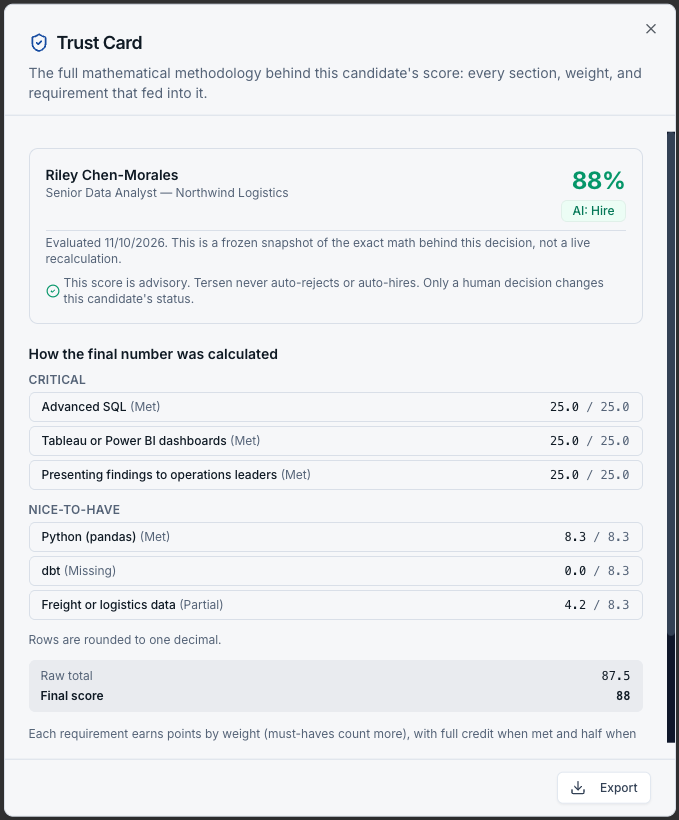
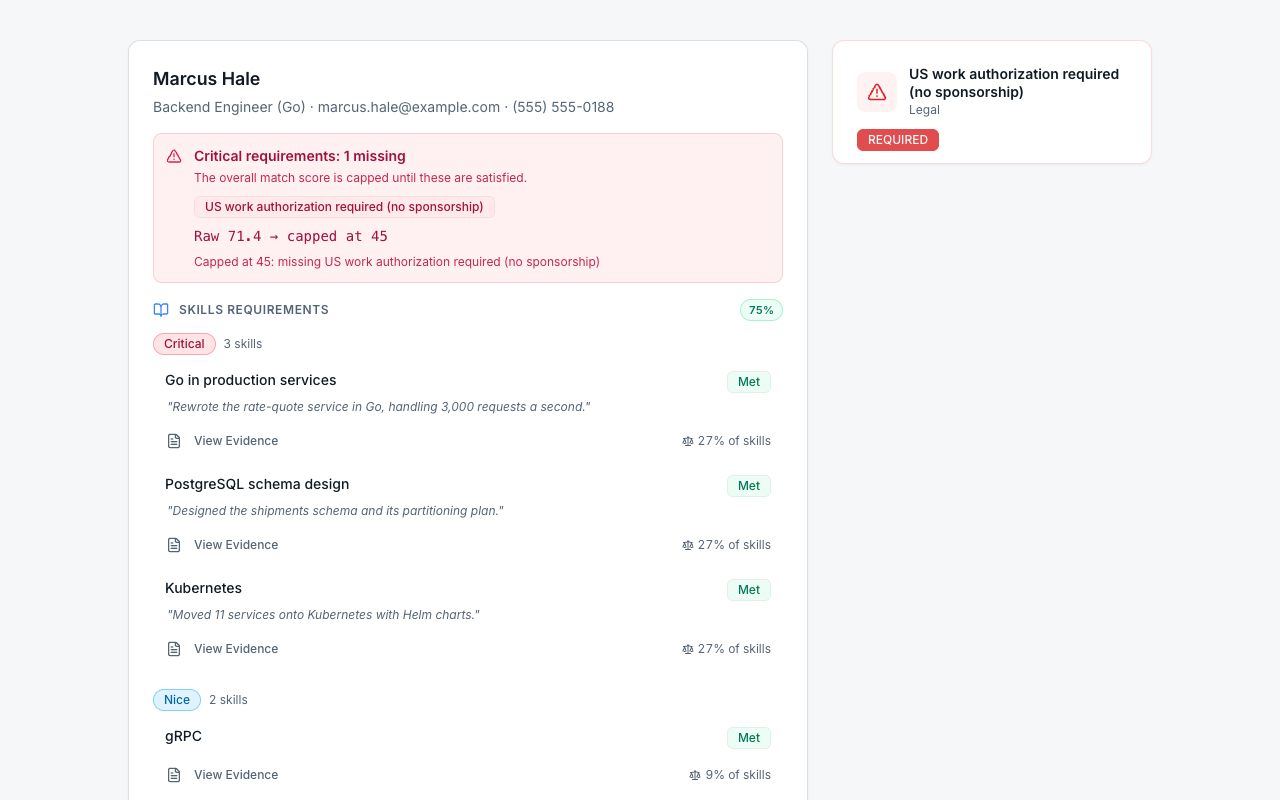
Trust CardFictional example
Hard constraintFictional example
A strong skills score never overrides a failed hard constraint, and you still decide.
Free to see, for every plan
The Methodology and every candidate's Trust Card are available on every plan, including free accounts and guests. Trust shouldn't be a paywalled feature.
See our Security & Trust Center