

Definition
AI resume screening uses artificial intelligence to read, evaluate and score applicants' resumes against criteria you define, so you start from a ranked, explained list instead of an unread pile.
Unlike simple keyword-matching filters (which have been around for decades in Applicant Tracking Systems), modern AI screening understands context. It can recognize that "led a team of 12 engineers" demonstrates leadership even if the word "manager" never appears.
The goal isn't to remove humans from hiring. It's to handle the mechanical reading and scoring work so recruiters can focus on the human elements: interviews, culture assessment, and candidate relationships.
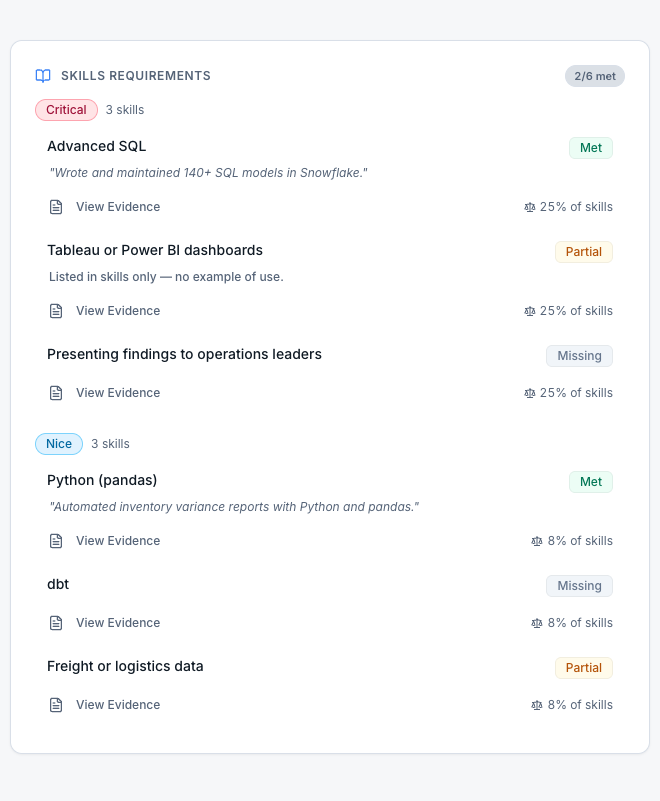
A score with the requirement matches behind it, not just a number.
Traditional Screening vs. AI Screening
Key Capabilities
Not all AI screening tools are created equal. Here are the capabilities that define a modern, effective system:
Evidence-based scoring
Scores are backed by specific evidence extracted from the resume — not just statistical patterns or keyword counts.
Structured criteria
Evaluation is driven by defined requirements with priority tiers, not vague job descriptions or historical hiring data.
Triage with a suggestion, not a verdict
Each candidate gets an AI suggestion (Hire, Maybe or Pass) with the evidence behind it. A person makes every decision.
Explainable decisions
Every score can be inspected. Recruiters see exactly why a candidate scored high or low, building trust in the system.
Fidelity-verified parsing
AI extracts resumes into clean, structured sections (Experience, Skills, Education). A fidelity check compares the parsed version against the original text and flags anything that may differ. Toggle between parsed and original views at any time.
Pipeline management
Beyond screening, candidates move through pipeline stages you define, with notes on each one.
Consistent criteria
Every resume is judged against the same written requirements, which makes each decision easier to check and explain. It doesn't replace human judgment.
What to Look For in an AI Screening Tool
Evidence you can check — Every score should point to the resume line it's based on.
Criteria you control — You write the requirements and decide what's a must-have.
A person makes the call — The tool suggests. Nothing is rejected without you.
Honest about limits — No tool can prove who wrote a resume. Be wary of any that claims to.
Your data stays yours — Candidate data should never be sold or used to train models, and you should be able to export it.
Fits how you work — Exports your other tools can read, like CSV or JSON.
Common Concerns — Addressed
Will AI introduce bias?
It depends on what the AI scores against. Tools that learn from past hiring decisions can repeat old patterns. Scoring against requirements you write down, with the evidence shown for every score, lets you check each decision. Tersen scores against your Role Card, not against past candidates, and a person makes every call.
Is it a 'black box'?
Many AI tools are opaque — they give you a score but won't explain it. Explainable AI solves this by showing the evidence behind every score. Tersen's Evidence-First Scoring shows exactly which requirements were matched, what evidence was found, and where gaps exist.
What about data privacy?
Resume data is sensitive. Look for platforms that encrypt data in transit, don't sell candidate data, and let candidates have their data exported or deleted. Tersen never sells candidate data and never uses it to train models.
Will it replace recruiters?
No. AI screening handles the mechanical work — reading, extracting, scoring — so recruiters can focus on the human work: interviews, culture fit, candidate experience, and relationship building. It's a tool that makes recruiters more effective, not obsolete.
Can AI screening tools tell if a resume was written by AI?
Not reliably. AI-writing detectors are known to misfire, often on people writing in a second language, and a polished resume isn't a bad candidate. The more useful question is whether the claims are specific and backed up. Tersen checks specificity, never authorship.
Who Benefits?
Solo recruiters
Handle more roles without cutting corners: the reading is done, and every score shows the line it's based on.
Hiring managers
Get shortlists backed by evidence, not just recruiter intuition. Understand why each candidate was recommended.
Talent teams
Scale screening across multiple roles and team members with consistent criteria and auditable decisions.
How Tersen Approaches AI Screening
Tersen was built around a core belief: every hiring decision should be backed by evidence, not gut feel.
Our Evidence-First Scoring engine reads each resume against your structured Role Card — a prioritized set of requirements you define for the role. For every requirement, the AI extracts specific evidence from the resume and scores the match.
The result is a transparent, explainable score. You can see exactly which requirements were met, which were partially met, and which were missed — along with the specific resume evidence that supports each assessment.
Combined with one-click triage and pipeline stages, Tersen takes you from a pile of resumes to a shortlist you can stand behind, with the evidence at every step.
Related Reading
See It in Action
Try our interactive demo to see how AI resume screening works — no sign-up required.